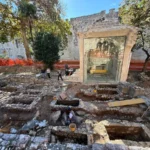

For weeks now we’ve been stopping on our way home to lean on the fence and watch. About thirty metres as the crow flies from our Palace apartments, beside the northern wall of Diocletian’s Palace, archaeologists are uncovering a church that most visitors walk past without knowing it was ever there.
A church built from the emperor’s own stone
The walls emerging from the soil belong to the church of St Benedict, later called St Euphemia, built in the first half of the 11th century. It had three aisles, three rounded apses and a small dome, and its builders did what people in Split have always done: they helped themselves to Diocletian’s palace. Some of the columns that held up the roof were Roman, carried over from next door. Around 1068 the archbishop of Split founded a convent of Benedictine nuns here, and they stayed for more than seven centuries.
The archbishop who was stoned to death
The glass-fronted chapel in the middle of the site tells the darker part of the story. In 1180 Arnir, archbishop of Split, rode into the hills of Poljica to settle a dispute over church land and was stoned to death. He was buried with the nuns, and locals soon called the whole place St Arnir’s. Between 1444 and 1448 the convent hired Juraj Dalmatinac, the master behind Šibenik Cathedral, to build him a Gothic chapel and a carved sarcophagus showing the killing itself. Art historians consider it the first time a real event from local history was carved in stone here. The original sarcophagus now stands in the parish church at Kaštel Lukšić; the chapel holds a copy, and Arnir’s relics rest in Split Cathedral.
Fire, bombs and a second chance
Napoleon’s administration closed the convent in 1806 and turned it into a military hospital. A fire in 1878 destroyed the church, bombs damaged what was left in 1944, and in 1946 the ruins were cleared to open the view of the palace wall. Only the chapel and the slender bell tower, finished around 1710, were spared. Conservators first excavated the site in 1946 and 1947.
Today’s dig, run by the City of Split with support from the Ministry of Culture and Media, reopens that ground with modern methods. It is planned to last five months and will shape how the site is finally presented to the public.
Come and look
You’ll find it on the green strip outside the northern wall, a few steps from the Golden Gate and the statue of Grgur Ninski. The site is fenced, but everything is easy to see from the path, and watching is free.
Stay at Kaleta Apartments and it’s a one-minute walk. Our Location & Getting Here page shows the way, and the 3-day local guide covers the rest of the palace.